


ioX-Connect Platform
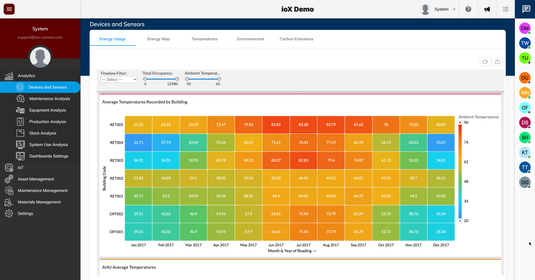
ioX-Connect Remote Monitoring Systems offers a comprehensive cloud-based platform designed to manage an array of over 100 sensors types, as well as integrate with your existing monitoring tools. Our platform serves as the command center for your devices, allowing you to tailor their settings to your specific needs and operational processes.

Frequently Asked Questions about LoRaWAN Sensors
LoRaWAN (Long Range Wide Area Network) is a low-power, long-range wireless protocol designed for IoT applications. It operates in sub-GHz bands to provide kilometers of coverage on a single battery charge, unlike Wi-Fi or Bluetooth which trade range for higher data rates. Check out ourWhat is LoRaWAN Guide.
A LoRaWAN network is an open, standards-based infrastructure that allows wireless devices—regardless of brand, model, or network provider—to seamlessly connect, communicate, and transmit data over long distances. Built on widely adopted LoRa technology (supported by organizations like The LoRa Alliance® and hardware from companies such as ioX-Connect and MultiTech), a LoRaWAN network acts as the backbone for unified device management.
This interoperability means you can onboard and monitor LoRa-based sensors from different manufacturers on a single platform, no matter who makes the devices or provides the connectivity. With secure, bidirectional data flow, you gain centralized visibility, control, and real-time analytics for all connected devices—simplifying expansion and ensuring future-proof scalability across any facility or set of use cases.
In ideal rural environments, LoRaWAN sensors can reliably transmit data up to 10 km from the gateway. In urban or obstructed areas, you can expect several kilometers of range—enough to cover entire campuses or multi-building sites.
A pre-provisioned LoRaWAN gateway like those offered by ioX-Connect takes the heavy lifting out of deployment:
- Out of the box, it’s ready to go—network configuration, security keys, and app integrations are already handled.
- Sensors join seamlessly with zero manual pairing and instantly appear in your dashboard.
- You bypass all the headache of linking the gateway to the network server and integrating that with your IoT platform—everything is connected from the start.
On the flip side, gateways that aren’t pre-provisioned require a fair bit of manual setup. Expect to:
- Spend extra time configuring network details, authentication, and server connections.
- Tackle every integration step yourself, with potential troubleshooting along the way.
- Take on additional security configuration responsibilities to ensure safe device communications.
In short: pre-provisioned gateways dramatically accelerate setup, minimize IT effort, and let you focus on scaling your deployment rather than wrestling with infrastructure.
Thanks to ultra-low-power modulation, most LoRaWAN sensors last 5 years or more on a standard lithium battery, depending on reporting frequency and environmental conditions. For sensor specific battery life, check out our LoRaWAN hardware catalog.
LoRaWAN uses AES-128 encryption at both the network (NwkSKey) and application (AppSKey) layers. Combined with ioX-Connect’s role-based access controls, this ensures end-to-end protection and prevents unauthorized data access.
How LoRaWAN Keeps Data Secure
The LoRaWAN security stack is built on top of LoRa modulation (PHY) and adds a robust security layer with unique device identity, authentication, and authorization for every sensor and gateway. Symmetric AES-128 keys—defined in the IEEE 802.15.4/2006 Annex B—are generated for each device. The Network Session Key (NwkSKey) encrypts network-related messages, while the Application Session Key (AppSKey) encrypts application-specific data, so only your application ever sees the payload.
Importantly, LoRaWAN gateways operate much like routers: they securely forward data between devices and the cloud using protocols such as DTLS, TLS, or VPN, but never decrypt or access your data or keys. This architecture ensures that your sensor data remains private and protected end to end, even as it travels across public or shared infrastructure.
Yes. LoRaWAN is an open standard, so you can deploy most LoRaWAN gateways and devices alongside other ioX-Connect certified sensors—our platform ensures seamless, zero-touch integration regardless of the vendor.Alternatively ioX-Connect offers our own range of affordable LoRaWAN Gateways and Devices. Please reach out to us at:sales@iox-connect.comto find out if the LoRaWAN devices you are considering is certified for use in our platform.
LoRaWAN excels in scenarios requiring wide-area coverage and infrequent small data packets, such as environmental monitoring (temperature, humidity, air quality),predictive maintenance(vibration, pressure), andasset trackinginagriculture,smart buildings, andindustrial settings.
A single gateway can handle hundreds to thousands of sensors, depending on reporting intervals and network traffic. This star-of-stars architecture scales easily as you add endpoints. Reach out to our sales team at:sales@iox-connect.comif you need specifics or check out our range ofLoRaWAN Gateways.
No—LoRaWAN’s robust modulation penetrates walls and obstructions. While line-of-sight can maximize range, most indoor and urban deployments work reliably without it.